
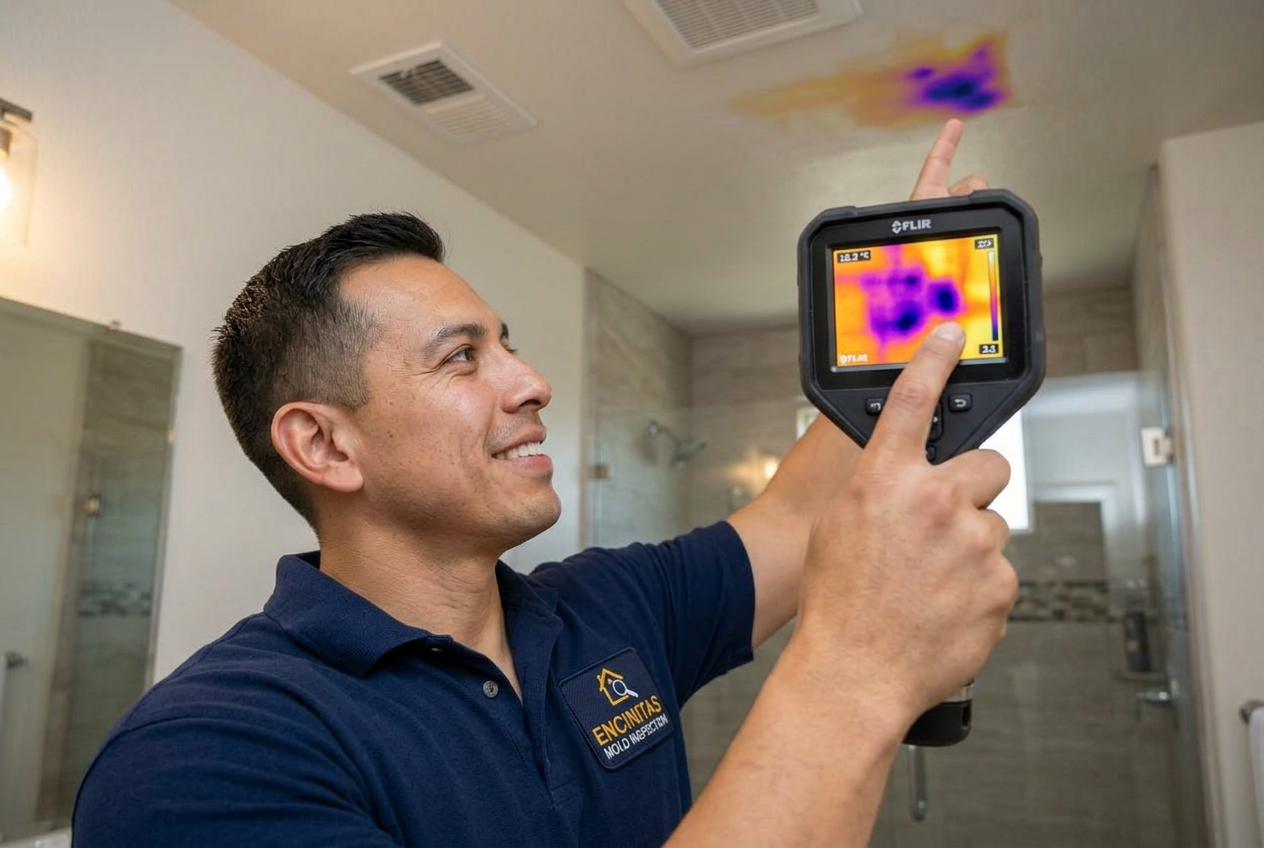
What thermal imaging reveals
A thermal camera doesn't see mold, and it doesn't see moisture directly — it sees temperature. Wet materials evaporate and cool differently than dry ones, and hidden leaks create thermal signatures on the surface of a wall or ceiling long before staining appears.
How we use it
We scan every room, focusing on plumbing walls, HVAC areas, exterior walls, windows, roof lines, ceilings under bathrooms and floors around fixtures. Any anomaly is verified with a calibrated moisture meter — the two tools together are dramatically more accurate than either one alone.
What thermal imaging can't do
It doesn't see through walls, doesn't detect mold spores, and doesn't work well when the wall surface and the moisture behind it are the same temperature. That's why we combine imaging with moisture meters, borescopes and air sampling.
Thermal imaging in your report
Relevant thermal images are included alongside standard photos, with a short interpretation of what each image shows and why it matters.
Included with every mold inspection
Thermal imaging is standard on every mold inspection we perform in Encinitas — never an upsell.